At DIGITAL X in Cologne, hardly anyone was still asking whether companies should use AI. The focus was on how to make it work day to day, and who makes it happen. Five observations, and what they mean for companies and IT professionals.
AI has arrived in the enterprise
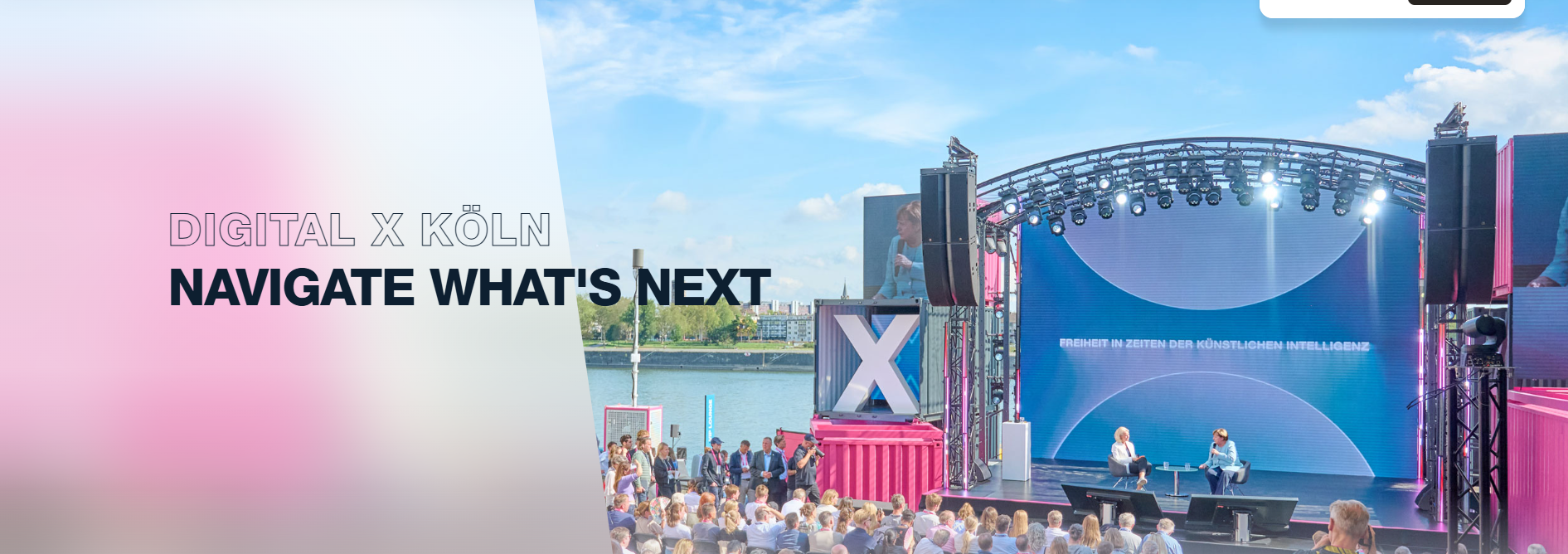
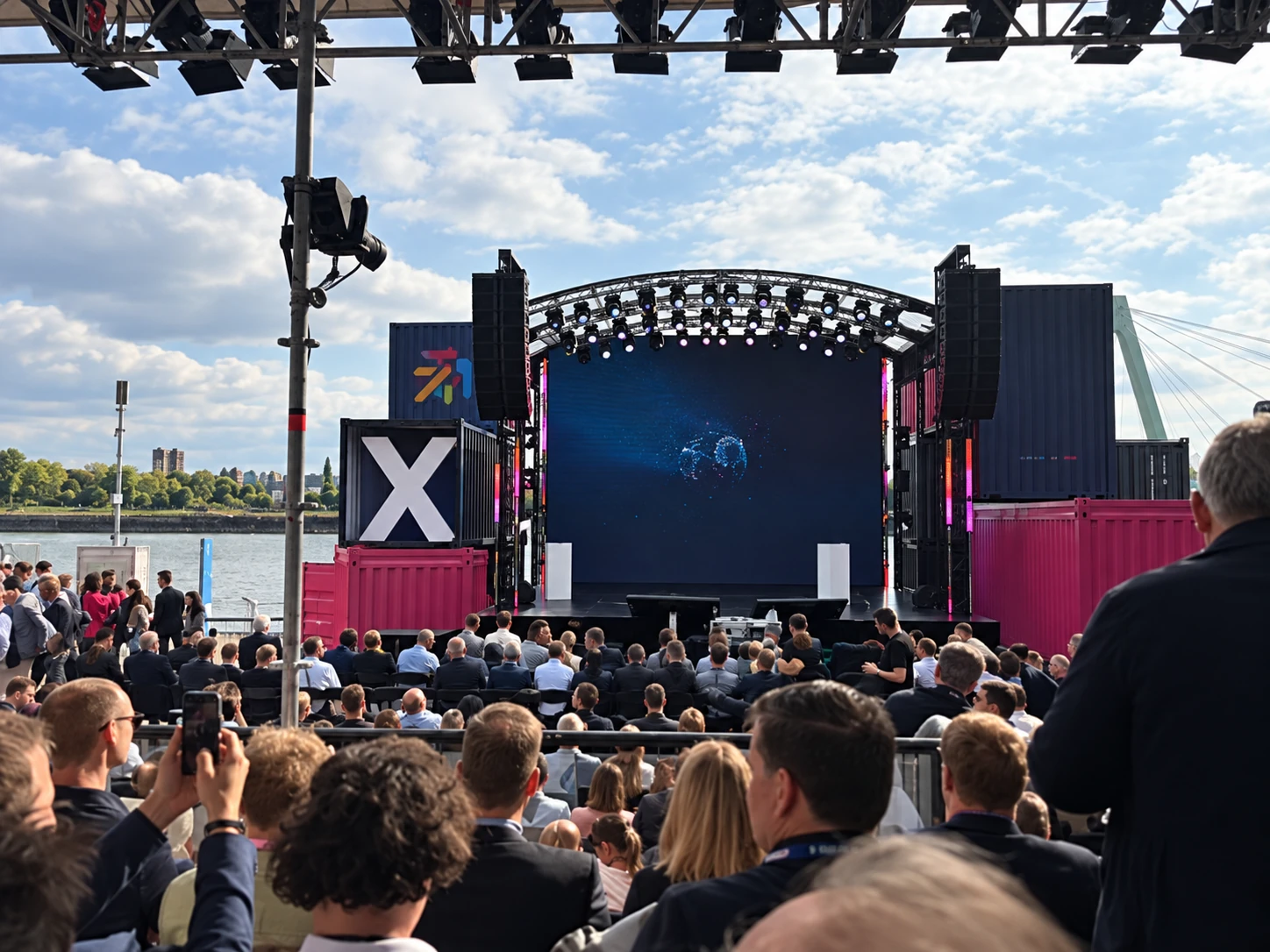
This year DIGITAL X at Cologne’s Rheinauhafen showed just how broad the AI debate has become. The main stages featured Angela Merkel, Robert Habeck, Alena Buyx and Yuval Noah Harari, among others, while the were less covered industrial AI, sovereign infrastructure, cloud, cybersecurity und future skills.
At eAces we mainly fill management, IT and AI roles. So we were particularly interested in what companies need to bring AI into everyday operations, and which skills that takes.
Whether to use AI is hardly up for debate any more. According to a survey published by Bitkom in September, 57 per cent of German companies with 20 or more employees now use AI, up from 36 per cent a year earlier and just 20 per cent two years ago. Yet almost nine in ten of them say they are making little or no use of its potential. The real question now so that it actually delivers, runs securely and remains accountable.
Less showcase, more engine room
The masterclasses were less about what AI can generate and more about what it takes to run it properly inside a company. At theSAP x T-Systems session on high-performance AI for a digitally sovereign Europe, and at “Industrial AI in Practice” with Wandelbots and SupplyOn, much of the discussion revolved around computing capacity, company data, platforms, security and compliance. In short: the engine room.
According to Eurostat, 20 per cent of EU businesses with ten or more employees used AI in 2025, up from 13.5 per cent the year before. Among large companies the figure was 55 per cent, compared with 30 per cent of medium-sized and just 17 per cent of small firms. Eurostat itself suggests some possible reasons: the complexity of implementing AI, economies of scale and cost.
The sessions in Cologne made it clear that productive AI takes far more than a licence for a chat tool. Bitkom’s latest figures point the same way. For companies already using AI, the biggest cost items are infrastructure such as cloud and computing power (51 per cent), data preparation (50 per cent) and integration into existing systems (41 per cent). Only 21 per cent count subscriptions and licences for AI software among their major costs. The expertise required is just as broad: alongside data science, it calls for cloud architecture, data integration, IT security and compliance.
From assistants to agents
One of the most revealing slides of the day compared generative and agentic AI. Generative AI produces text, images or recommendations on request, and people stay in control of every step. Agentic AI, by contrast, pursues a goal, accesses other systems and works through a sequence of tasks. That means it can gradually take over entire parts of a business process.
In its report „Agentic Commerce and AI in E-Commerce“the market intelligence platform ECDB shows what this can look like in online retail: from AI that helps customers find products to agents that handle purchases and reorders entirely on their own. ECDB reckons the market is still at the first of four stages, but the direction is clear. Agents are on the agenda in Germany too. Among companies that use AI or are planning or discussing it, 11 per cent already deploy AI agents, according to Bitkom, 29 per cent are planning to and a further 31 per cent are discussing it.
The next phase of the AI transformation will not be determined by better models alone. What makes the difference is how consistently companies integrate technology, processes, and people.
Horst Niederberger, Managing Director of eAces GmbH
A Gartner forecast on sales makes for sobering reading. By 2028, AI agents are expected to outnumber human sellers ten to one. Yet Gartner expects fewer than 40 per cent of sellers to say the agents have made them more productive. Sales leaders who fundamentally overhaul data, automation and user experience, on the other hand, are set to be five times more likely to see a return on AI than those opting for quick fixes. What matters, then, is not the number of tools but how well they are embedded in data, processes and systems.
A new tool doesn’t make a better process
Once AI stops just answering and starts acting, introducing it becomes an organisational question. Who gets to decide what? Which steps does an agent handle, and which stay with people? And who is accountable when an automated process gets it wrong? We come across these questions all the time in transformation projects. AI makes them more urgent.

A report by the World Economic Forum and PwC shows how mixed the effects can be: 68 per cent of the entry-level workers surveyed say AI has made them more productive, but 45 per cent say they now work more overall. At the same time, companies with the strongest AI-driven financial results are twice as likely to redesign their workflows rather than simply bolting AI tools onto existing ones.
That matches our experience from client projects. Getting real value from AI means rethinking interfaces, responsibilities and decision paths, and working out how people and AI collaborate day to day. Existing tasks change along the way, and new ones emerge, for example around steering and monitoring AI systems.
Technology is outpacing skills
As a recruitment consultancy, we found the masterclass “Future Skills sichtbar machen” (Making Future Skills Visible) particularly relevant, with its focus on the skills people need in a working world shaped by AI.
Companies have started to respond. According to Bitkom, 70 per cent now train their employees in using AI, and the share offering no training at all has fallen from 43 to 25 per cent within a year. But there is still a lot of catching up to do: two thirds of companies rate their employees’ AI skills as low. According to the WEF and PwC, 63 per cent of young workers in Europe are in occupations with medium to high exposure to AI-driven task change. That doesn’t mean these jobs will disappear, but it does mean the requirements are shifting.
For companies, this means two things. They need to develop their own people, and do it now rather than after the next pilot project. And in some areas they will need outside experts, because the know-how simply doesn’t exist in-house yet, for example in AI architecture, data management or AI governance.how itcalls for flexible models, from permanent hires to project-based assignments. The gap is real: according to Bitkom, 85 per cent of companies not yet using AI say they lack the technical know-how to implement it.
For IT and AI professionals, the flip side is this: the people most in demand are those who not only master the technology but also understand how it fits into processes, data and governance. The jobs outlook is mixed, though. In the Bitkom survey,57 per cent of companies expect AI to reduce their headcount over the next two years, but companies already using AI are twice as likely as non-users to expect headcount to grow (18 versus 9 per cent).
AI is now a political issue too
When a former German chancellor, a former economy minister, a medical ethicist, a historian and a philosopher all take the stage at a digital conference, it shows that AI is no longer just an IT topic. It is about sovereignty, responsibility and ethical boundaries. The public sees it the same way: according to Bitkom, 76 per cent of Germans believe AI is already changing society or will noticeably do so within the next five years.
As a result, the way companies use AI is increasingly being watched by customers, employees and lawmakers. Regulation is already making itself felt: According to Bitkom, 37 per cent of companies now expect to be affected by the EU AI Act as users, up from 23 per cent a year earlier, and 89 per cent of those affected or still assessing whether they are expect a high implementation effort. Anyone introducing AI should factor that in from the start.
Processes and people make the difference
The next phase of AI transformation won’t be decided by better models alone. What makes the difference is how consistently companies bring together technology, processes and people. That takes solid infrastructure and clean data, but also rethought processes, clear responsibilities and people who are able and willing to work with the technology.
It’s less glamorous than the next product launch. But this is where a pilot project either turns into something that holds up in daily operations or doesn’t. And when it comes to finding the right expertise, it pays to look beyond the individual role to the team as a whole.
WE ARE eACES
It doesn't cost anything to ask. Literally.
Let’s talk about the position you need to fill, the scope of responsibilities, your upcoming consulting project, the business case, and your goals. Together, we’ll clarify the requirements and characteristics of the role and give you an honest assessment of the hiring options. With us, you’ll get a “no” just as quickly as a “yes.”