The AI@Strategy Conference in Munich highlighted how AI is changing not only workflows, but also collaboration and decision-making. Three observations on what these developments mean for leadership roles.
Picture a weekly operations review. An AI system has already shifted capacity between three sites, flagged two suppliers as at risk and drafted the recommendation the board will see. The figures are consistent, the reasoning is well presented, and the meeting is short. Nobody asks how the system weighed delivery risk against cost. Nobody is quite sure whose job it would be to ask.
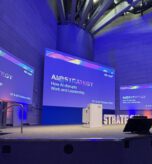
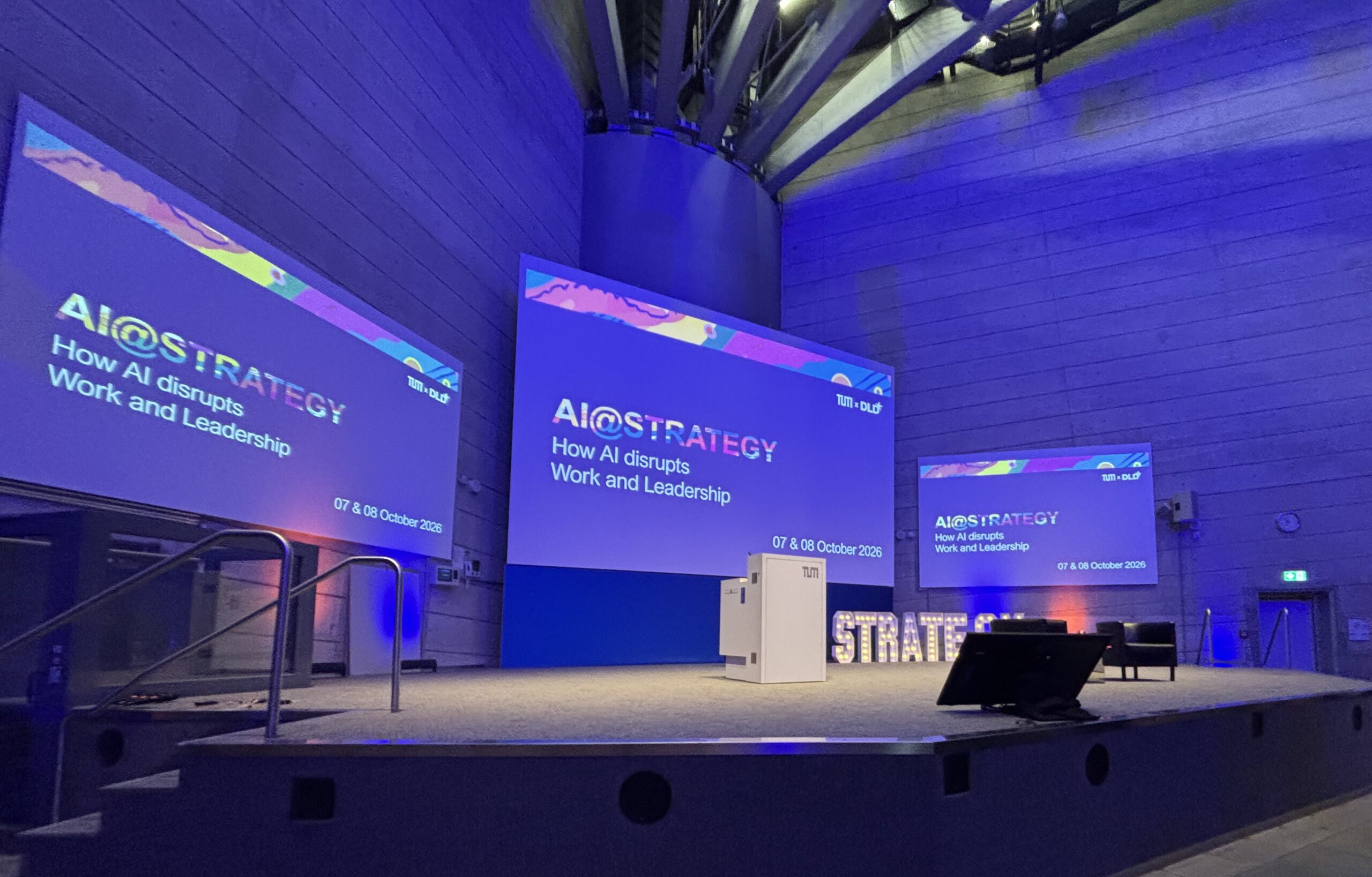
That kind of dilemma ran through many sessions at the AI@Strategy Conference, held at the Technical University of Munich on 7–8 October 2026 with the involvement of DLD. What struck me most was how far the conversation has moved. Much of it focused on AI systems that coordinate work, recommend decisions and increasingly carry them out.
Our recent article following DIGITAL X explored what it takes to integrate AI into everyday business operations. The discussions in Munich raised a different question: how do responsibilities change when AI systems begin to coordinate work and make decisions that previously belonged to people?
When AI changes who works with whom
Most discussions about AI productivity focus on how much more individuals can accomplish. Sameer Srivastava, professor at UC Berkeley's Haas School of Business, explored something less visible: how AI changes collaboration within organisations.
His presentation, AI Workflows and Collaboration, examined whether AI-enabled workflows reinforce dependence on established experts and coordinators or make knowledge more accessible across teams.
The research draws on work-management data from 25,650 organisations, observed monthly between July 2024 and March 2026. Preliminary findings suggest changes in collaboration networks, although Srivastava acknowledged that a causal relationship with AI has not yet been established.
The question is nevertheless relevant for businesses. Those who coordinate work often hold considerable influence: the project manager who knows whom to contact when a problem arises, or the IT architect through whom important technical decisions pass.
If AI makes expertise easier to access, some of these bottlenecks could disappear. Others may simply shift towards those who configure AI workflows, manage data or determine which systems agents can access.
For COOs, department heads and HR leaders, this raises two important questions: how do collaboration and responsibilities change when AI increasingly connects knowledge and tasks across teams? And how can organisations ensure that this creates new connections rather than simply shifting existing dependencies?
Why convincing AI recommendations are not always correct
Christopher L. Tucci highlighted another challenge in his presentation, Scaling AI Governance: as AI recommendations become more sophisticated, critically evaluating them becomes increasingly important.
AI delivers results in seconds, communicates confidently and processes large amounts of data. This can make its recommendations appear more objective and reliable than they actually are. The risk is that people trust the results too readily.
A 2025 study by Microsoft Research and Carnegie Mellon University supports this concern. The researchers surveyed 319 knowledge workers, collecting 936 examples of generative AI use at work. Participants who expressed greater confidence in AI reported less critical-thinking effort, while those with greater confidence in their own abilities reported more. These findings are based on self-reported behaviour and do not establish causation. They nevertheless suggest that trust in AI can influence how critically people assess its outputs.
For executives, project managers and functional leaders, approving an AI recommendation should therefore be more than a formality. It means examining the underlying assumptions: what data informed the result? What information might be missing? And how does the current situation differ from the cases the system has encountered before?
This leads to another question: how independently should AI be allowed to act?
Tucci presented a governance framework that distinguishes AI systems according to their level of autonomy and the organisational reach of their decisions. Zia Hoshyarzai, CIO and COO of BayernLB, outlined four operating modes in banking:
AI-assisted: AI provides recommendations; people decide and execute.
AI-enabled: AI performs individual steps; people supervise and approve.
AI-led: AI becomes the default executor within strict guardrails.
Autonomous: AI independently optimises outcomes in suitable, clearly defined domains.
The more independently AI operates, the more important clear responsibilities and effective controls become. Hoshyarzai emphasised that human oversight only works when those responsible have the necessary information, authority and time to critically evaluate AI-supported processes. Human approval alone does not necessarily amount to meaningful oversight.
Existing regulatory and risk-management frameworks reflect the same principle. The NIST Generative AI Profile addresses the risk of excessive reliance on automated outputs. Article 14 of the EU AI Act requires high-risk AI systems to be designed and developed to enable effective human oversight. This includes understanding system limitations, interpreting outputs and intervening when necessary.
What this means for leadership roles
From my perspective, this raises one of the most important questions for organisations: AI is changing not only how work gets done, but also what leaders need to deliver. Businesses should therefore reassess the requirements of four key leadership functions.
CIOs and CTOs must define how independently AI systems can operate. Which decisions can agents make on their own, when is human approval necessary, and how can automated actions be monitored or reversed? This is where technical responsibility and business decision-making increasingly intersect.
COOs and transformation leaders need to rethink how people and AI work together. When AI agents coordinate tasks across departments, established decision-making processes may change. The challenge is to ensure that responsibilities and accountability remain clear.
Risk and compliance leaders must assess AI systems not only before deployment but also throughout their operation. Changes in data, applications or system behaviour can introduce new risks. Decision traceability and effective intervention mechanisms remain essential.
HR and talent leaders need to reconsider which capabilities managers will require. As AI takes on more analytical and coordination tasks, critical judgement, the ability to challenge automated recommendations and the willingness to take responsibility for outcomes become increasingly important.
What leadership demands now
The more decisions AI prepares or makes independently, the more important it becomes for leaders to critically evaluate those decisions. Even as AI takes on more tasks and coordinates more processes, people remain responsible for setting objectives, weighing consequences and questioning results. And that responsibility is becoming more demanding.
For businesses, this goes beyond choosing the right technology strategy. They need to consider whether their leadership roles, decision-making structures and competency requirements are evolving alongside technological developments.
This will increasingly shape which leaders and specialists organisations need for their technology and transformation projects — and whether AI genuinely strengthens their capabilities or simply adds another layer of complexity.
WE ARE eACES
It costs nothing to ask. Literally.
Let’s discuss the position you’re looking to fill, the scope of responsibilities, your upcoming consulting project, the business case and your objectives.Together, we’ll define the role’s requirements and the qualities needed for success, while giving you an honest assessment of the recruitment prospects.You can expect a clear answer from us. Whether the answer is yes or no, we will tell you promptly.